
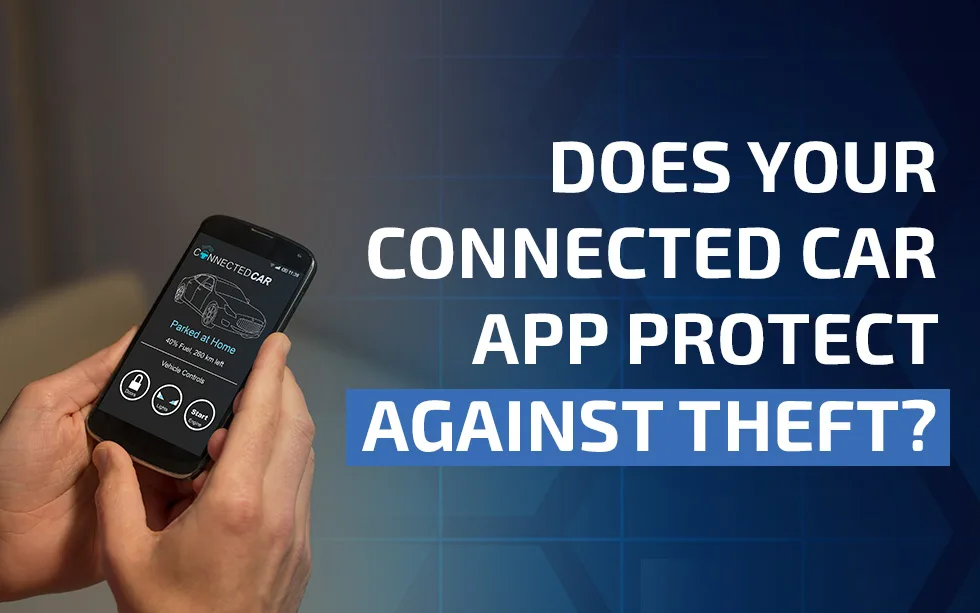
Most new cars now come with a manufacturer connected app as standard. According to the Society of Motor Manufacturers and Traders (SMMT), essentially all new cars sold in the UK were projected to be connected by 2026, up from around two-thirds in 2019 (Motoring Research). If you’ve bought a car in the last few years, there’s a good chance you already have one of these apps on your phone.
It’s easy to assume that an app showing your car’s live location doubles as theft protection. A recent BBC News investigation shows that assumption doesn’t hold up (BBC News). This article looks at what these apps can and can’t do if your car is stolen, what certified tracking systems like ScorpionTrack do differently, and where an immobiliser fits in.
The Case That Exposed the Gap
The BBC spoke to a technology analyst whose car was stolen from outside his house in March. He had a manufacturer connected app, a hidden Apple AirTag, and video doorbell footage of the theft taking place. On paper, that’s more visibility than most car owners ever have.
In practice, none of it got his car back. Thieves broke in without his keys, exploiting an unsecured process meant to let new owners transfer control of the vehicle, and disconnected his phone from the car through the infotainment system in moments. The AirTag was found and discarded. The manufacturer, told the BBC that its connected app “does not provide live-tracking functionality for stolen vehicles” because releasing location data is subject to GDPR and has to be done “in full compliance with all applicable laws.” The owner submitted eight separate location requests; each one took 24 to 48 hours to process, and by the time an answer came back, the car had already been moved out of the country. Its last recorded position was in Lithuania.
This isn’t a fault specific to one manufacturer. It reflects how connected car apps are built across the industry, and the manufacturer said as much itself, describing its connected service as a customer convenience feature rather than a certified security vehicle tracker.
So, does a Connected App Protect Against Theft?
Not in any way you can rely on, connected apps are built for owner convenience: remote locking, checking fuel or battery levels, servicing reminders, and sometimes a “last known location” feature. They were never designed as certified theft-recovery systems, and manufacturers are open about that distinction.
Thatcham Research, the UK’s vehicle security testing body, told the BBC there’s “a genuine and growing gap” between what consumers expect from connected features and what they’re actually capable of doing in a theft scenario. Its advice is to look for a device that’s independently certified specifically for stolen vehicle recovery, rather than assuming general connectivity will cover it.
Data access is slow by design
Location data is personal data under GDPR, so most manufacturers require a formal verification process before releasing it, even to the registered owner. In a standard theft, the police have no formal power to demand that data either, so the request sits with the owner. That process is built for privacy compliance, not the speed a theft demands, and a stolen vehicle can be out of the country within hours.
There’s no dedicated monitoring behind it
A connected app puts the burden of chasing recovery back on you: filing requests and waiting on the manufacturer to respond. There’s no professional monitoring centre acting on your behalf while the trail is still warm.
Thieves know how to switch it off
In the BBC case, thieves disconnected the owner’s phone from the car through the touchscreen in moments, using the same infotainment flaw that let them take control of the vehicle. Factory-fitted connectivity is easy to find and easy to defeat.
There’s no recovery process
Even when location data does come through, a delayed grid reference sent to a private individual isn’t a recovery. Someone still has to confirm the vehicle’s location and coordinate safely with the police.
What Makes ScorpionTrack Different
Most connected apps are built for convenience, not theft. ScorpionTrack‘s tracking units, including Quantum, S5, S5+ and S7, are standalone, independently certified devices installed by our network of approved engineers and built specifically for stolen vehicle recovery, not features bolted onto an infotainment system.
An independent power source, on Quantum3
ScorpionTrack Quantum3 doesn’t rely on the vehicle’s own battery or electrics. It’s covertly installed and carries its own independent power source, so it’s designed to keep transmitting even if thieves attempt to disable the car’s systems. That’s exactly the scenario that left the BBC case study owner with no location.
A 24/7 Secure Control Centre, not a self-service form
Rather than filing a request and waiting 24 to 48 hours, a hardwired ScorpionTrack S5 sends its theft alert straight to our 24/7 Secure Control Centre, who can act immediately. Once you’ve reported the theft to the police, we can liaise with them using established procedures. That cuts out the form-filling and multi-day wait built into the manufacturer app model.
Instant alerts on unauthorised movement on S5
ScorpionTrack S5 uses automatic driver recognition, so it knows when the vehicle is being driven by someone other than its registered driver. If that happens, you’re alerted in real time, connectivity depending on network coverage, rather than waiting on a manual location request the way the BBC case study owner did.
Thatcham approval
Many of ScorpionTrack’s products are independently certified against the standard Thatcham recommends owners look for a dedicated stolen vehicle tracking device and genuine real-time monitoring through a professional monitoring centre. Many insurers also recognise this certification with reduced premiums on higher-value cars and vans.
Built for recovery, not convenience
A connected app has to serve dozens of everyday functions, with theft response as an afterthought. ScorpionTrack products are designed for one job first, and it’s designed around doing that job fast.
Add an Extra Layer With an Immobiliser
A tracker gets your car back after it’s been taken. An immobiliser is designed to stop it being driven away in the first place, by preventing the engine from starting unless it recognises an authorised fob or PIN. Pairing the two covers both ends of the problem: the immobiliser makes the vehicle harder to steal, and the tracker gives you a fighting chance of recovery if a thief still manages to get around it.
This is worth factoring in given how the BBC case study played out. Thieves broke into that vehicle without the owner’s keys, using a flaw in the infotainment system to disconnect the connected app. . An immobiliser adds a barrier at exactly that point in the process, on top of whatever tracking is already in place. ScorpionTrack has a range of immobilisation options, including both Thatcham-approved and non-Thatcham-approved solutions, worth considering alongside a tracker rather than instead of one.
Do You Need Both?
There’s no reason not to keep using your car’s connected app for what it’s good at, like remote locking or checking fuel levels. The issue is only when it’s treated as your safety net against theft. Recovery rates have been improving too, from 42.48% in 2024 to 44.94% in 2025, according to DVLA lost-or-stolen data, but that still means more than half of stolen vehicles are never recovered. A certified tracker sitting alongside your connected app closes the exact gap the BBC’s case study exposed.
Compare that with what a monitored system delivers: in May 2026 alone, the ScorpionTrack monitoring team helped to recover £326,000 worth of stolen vehicles for our customers, including a BMW 330E located and recovered in just 10 minutes. That’s the difference between a professional monitoring centre acting on an alert straight away and the 24-to-48-hour wait the BBC case study owner faced.
FAQs
Does my car’s connected app protect me if it’s stolen?
Not reliably. Connected apps are built for convenience features like remote locking, not certified theft recovery, and manufacturers are often legally restricted from releasing live location data quickly.
Why did it take days for the BBC case study owner to get his car’s location?
Location data is treated as personal data under GDPR, so the manufacturer required a formal request and verification process each time, rather than providing instant access.
What does Thatcham Research recommend instead?
Thatcham advises owners to use independently certified stolen vehicle tracking units, with professional monitoring, rather than relying on general connected car features.
Is a Thatcham-approved tracker worth it for insurance?
Many insurers require a Thatcham-approved tracker on higher-value cars and vans as a condition of cover, and some offer reduced premiums when one’s fitted. Requirements and discounts vary by insurer, so it’s worth checking your policy for specifics.
How is ScorpionTrack different from my car’s built-in app?
ScorpionTrack connects to our 24/7 Secure Control Centre, which can act immediately on a theft alert, rather than requiring a manual request that can take days to process. Depending on the product, it can also include features like an independent power source (Quantum3) or automatic driver recognition that alerts you the moment the car is driven by someone unauthorised (S5).
Should I get a tracker or an immobiliser?
Ideally both. An immobiliser is designed to stop your car being driven away in the first place, while a tracker helps locate and recover it if a theft still happens. Together, they cover both prevention and recovery.
The Bottom Line
A connected app is a convenience feature that happens to include a map. It was never built to get a stolen car back, and the manufacturers behind these apps say so themselves. If theft protection is what you actually need, a certified, independently monitored tracker, ideally paired with an immobiliser, does the job the app can’t. Explore the ScorpionTrack range to find a Thatcham-approved solution for your vehicle, or speak to our team for tailored advice.